
One understanding.Every screen reads it.
The asset register, the architecture diagrams, the risk ranking, the compliance verdicts and the AI answers are all views of one dataset — not separate products stitched together. What follows are concept views of the platform.
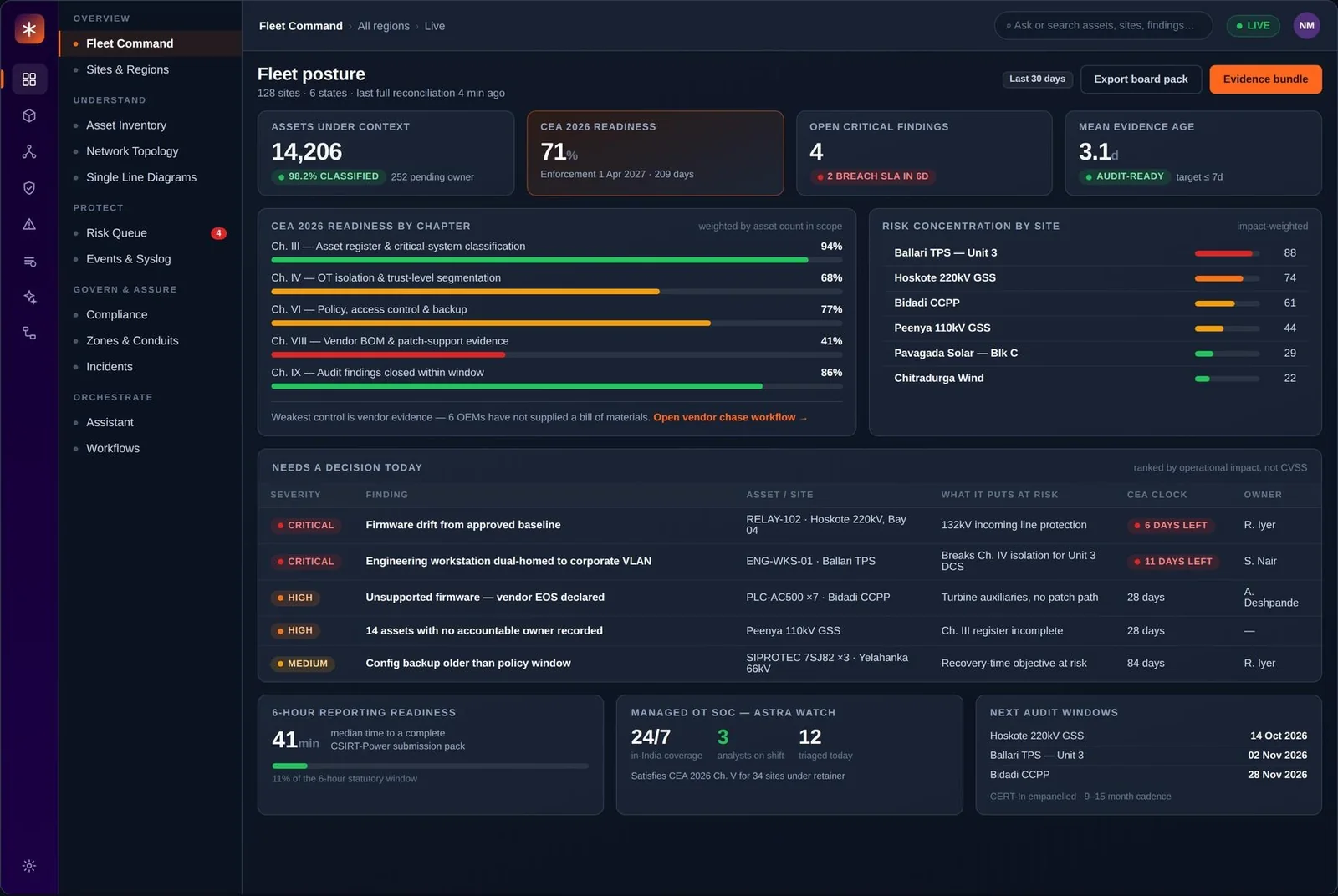
Fleet Command
One posture number per obligation, across every site — built to answer “are we defensible today, and where are we not” in seconds, not in a reporting cycle.
Each control area scored and weighted by the assets actually in scope, so the weakest obligation is obvious.
What needs a decision today, with the plant consequence and the statutory clock beside it.
If evidence is stale, the posture is a guess — so freshness is measured and shown.
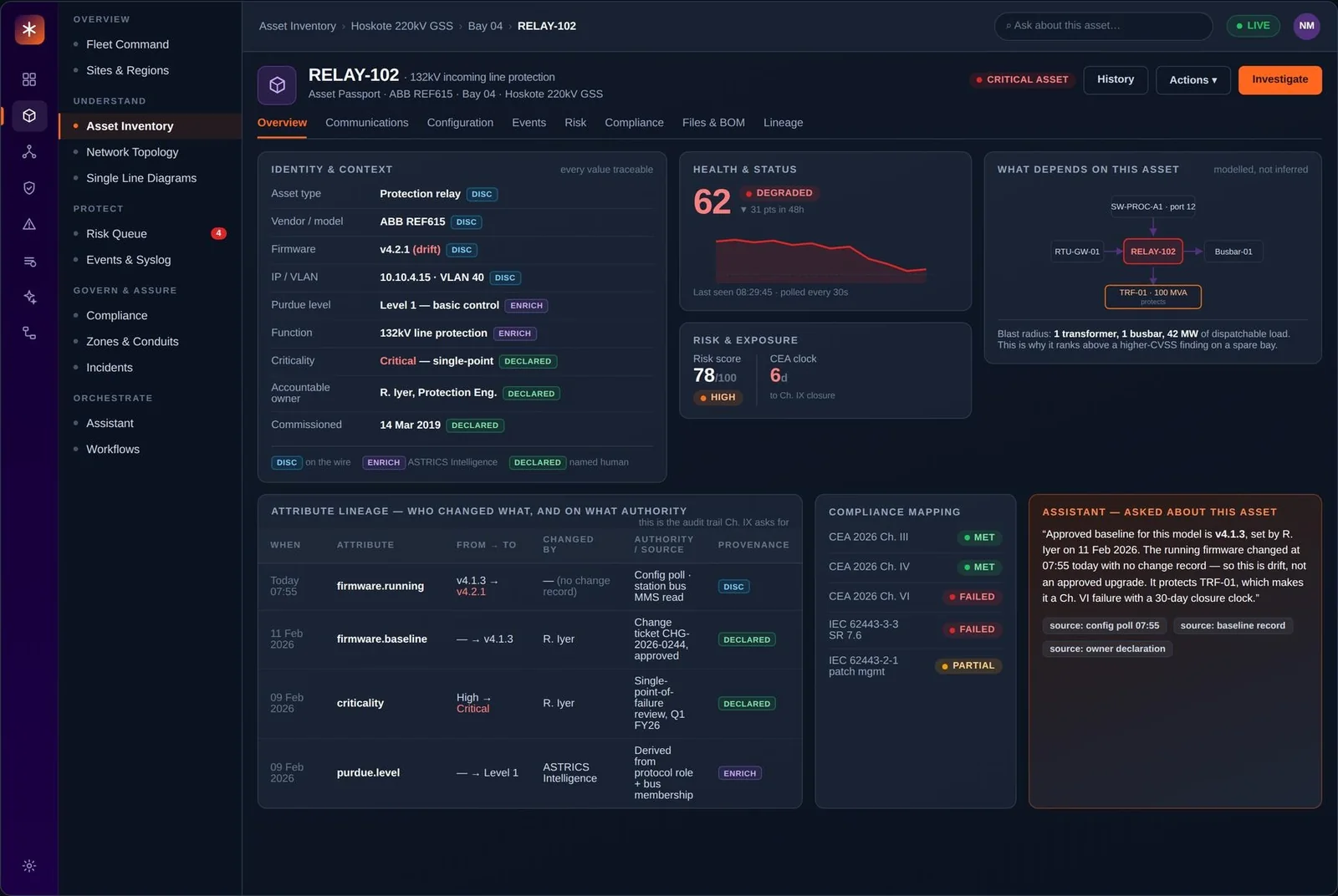
Asset Passport
One asset's complete operational record — and every value on it carries its source, so an auditor can follow any figure back to where it came from.
Discovered on the wire, enriched by ASTRICS Intelligence, or declared by a named human owner.
What this asset protects and what fails with it — modelled from declared relationships.
Who changed what, when, and on whose authority: the audit trail Chapter IX actually asks for.
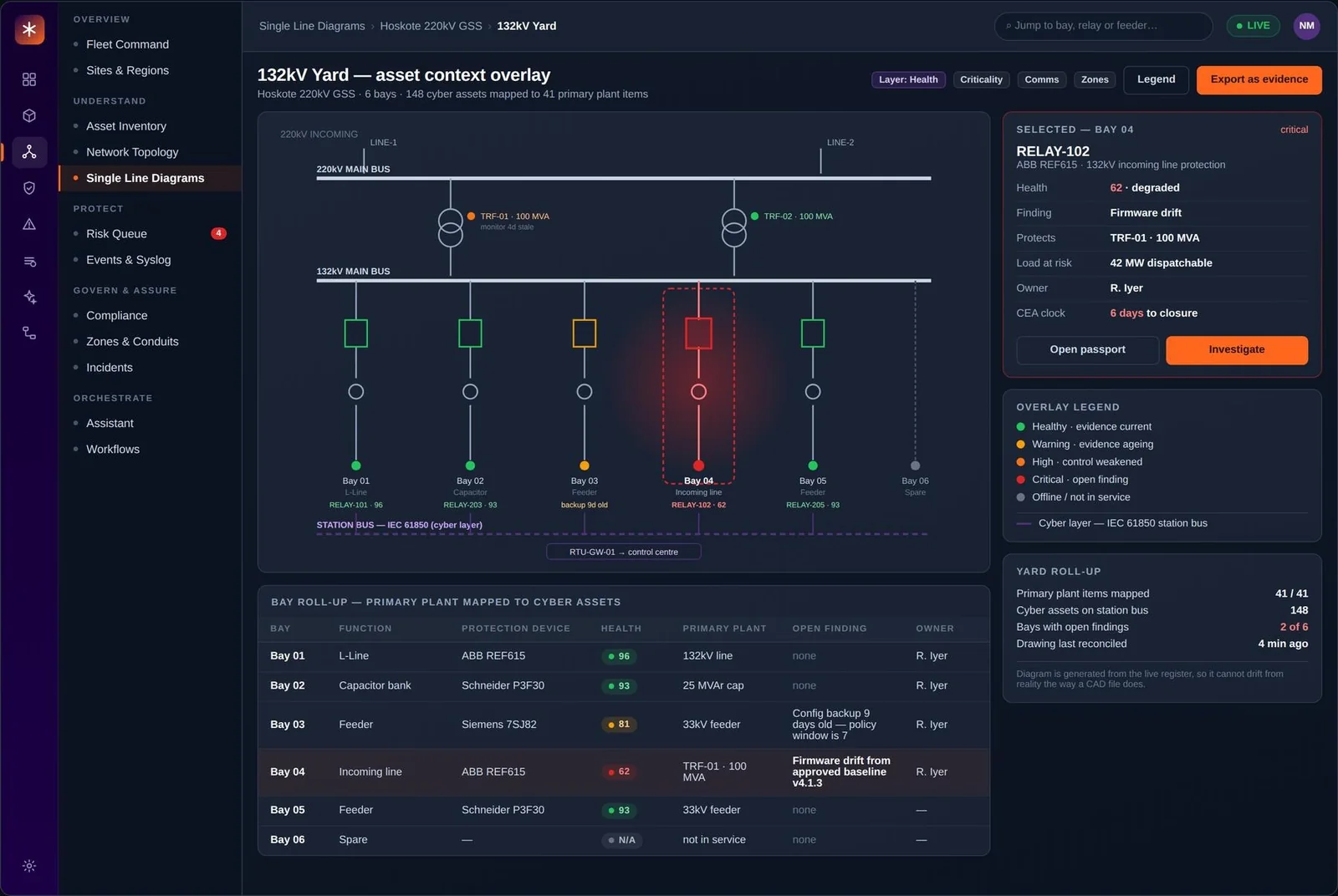
Single Line Diagram with Asset Context Overlay
The engineer's own drawing, alive. Cyber context is painted onto the layer operators already think in, so a finding reads as a bay, a transformer and a load.
The diagram cannot drift from reality the way a CAD file left in a drawer does.
148 cyber assets tied to 41 primary plant items — the mapping is the deliverable.
The same view an engineer reads is the artefact an auditor accepts.
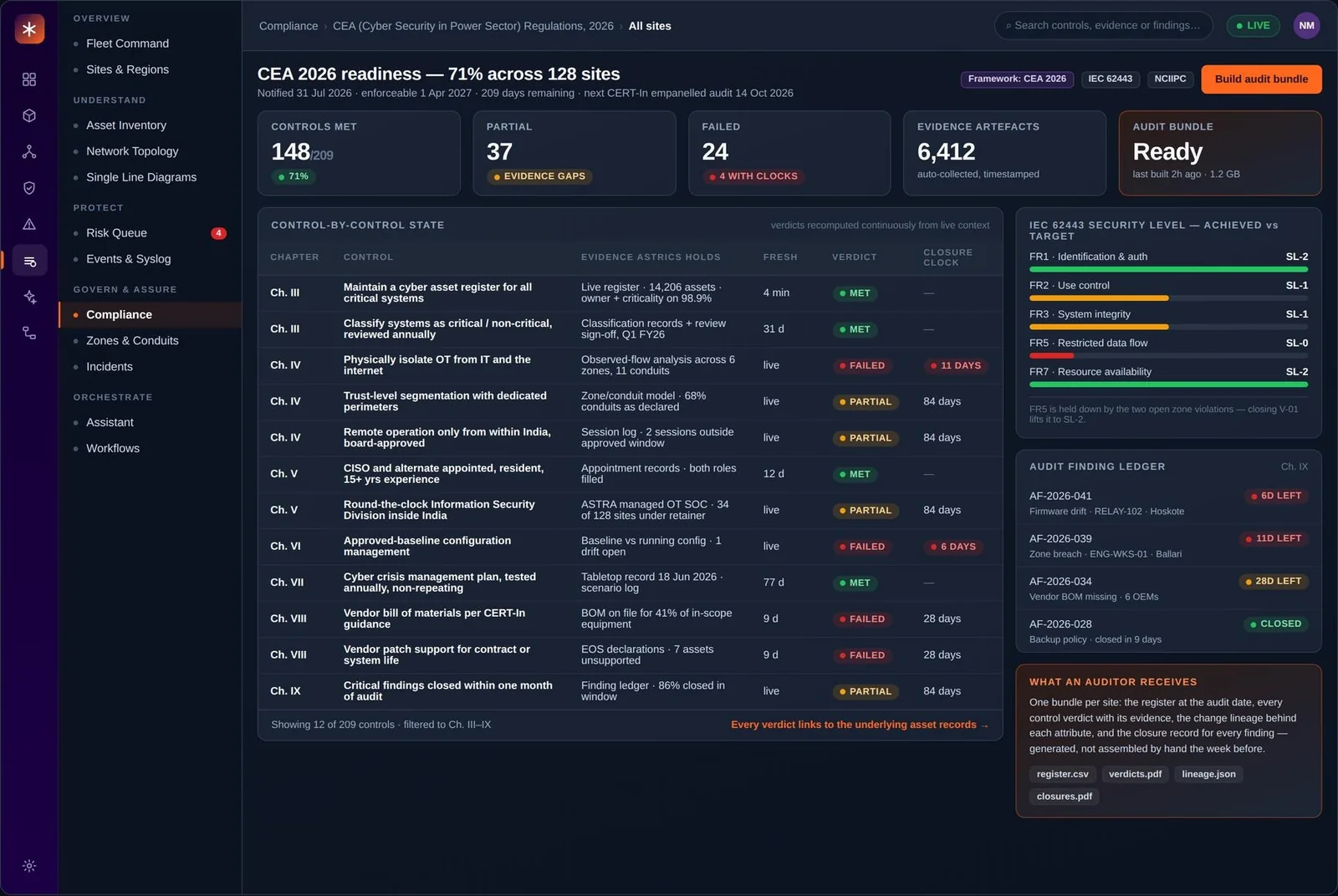
Compliance Console — CEA 2026 & IEC 62443
Compliance as a live state rather than an annual project: every control carries its current verdict, the evidence behind it, and the clock attached to any failure.
Recomputed continuously from live context, not reconstructed the week before an audit.
Chapter IX gives 30 days on critical findings — the ledger counts them down.
Register, verdicts, lineage and closures, generated rather than assembled by hand.
Asset Inventory
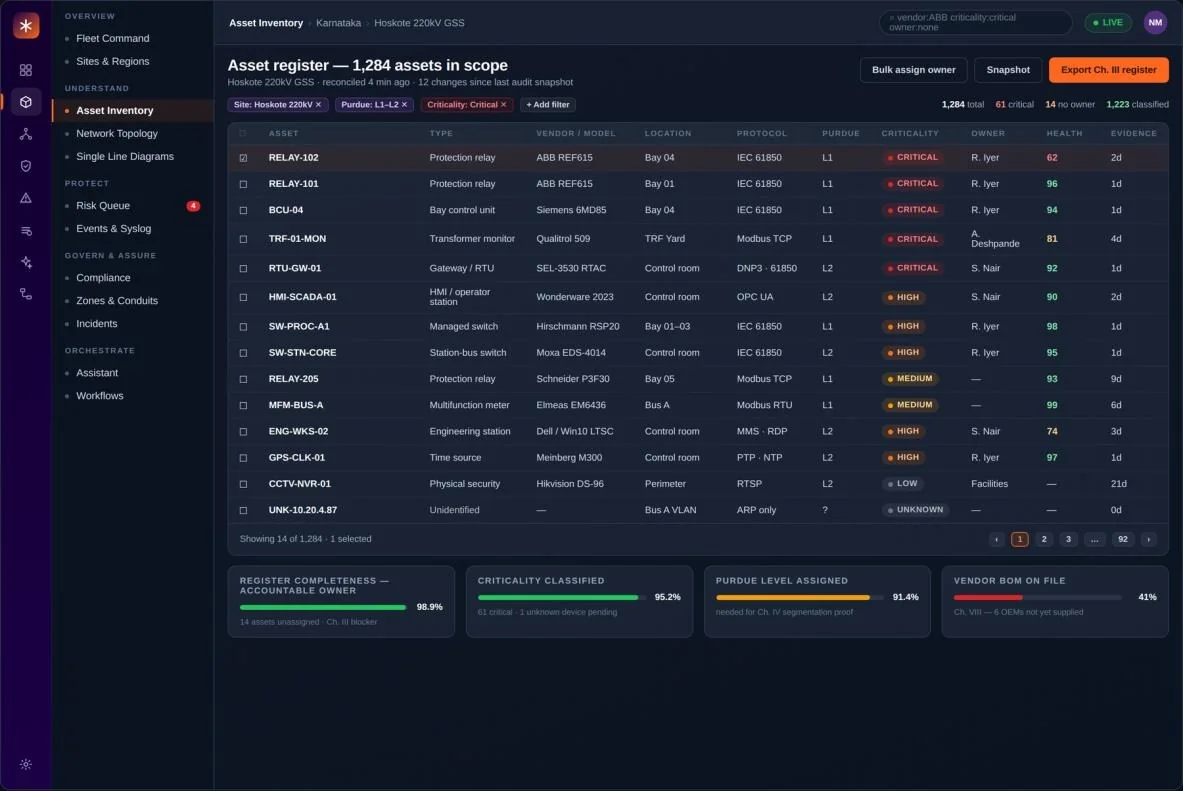
The Chapter III register as a living object. Accountable owner and criticality are first-class columns because the regulation asks for them — and completeness against each field is tracked, since an incomplete register is a failed control.
Zones & Conduits
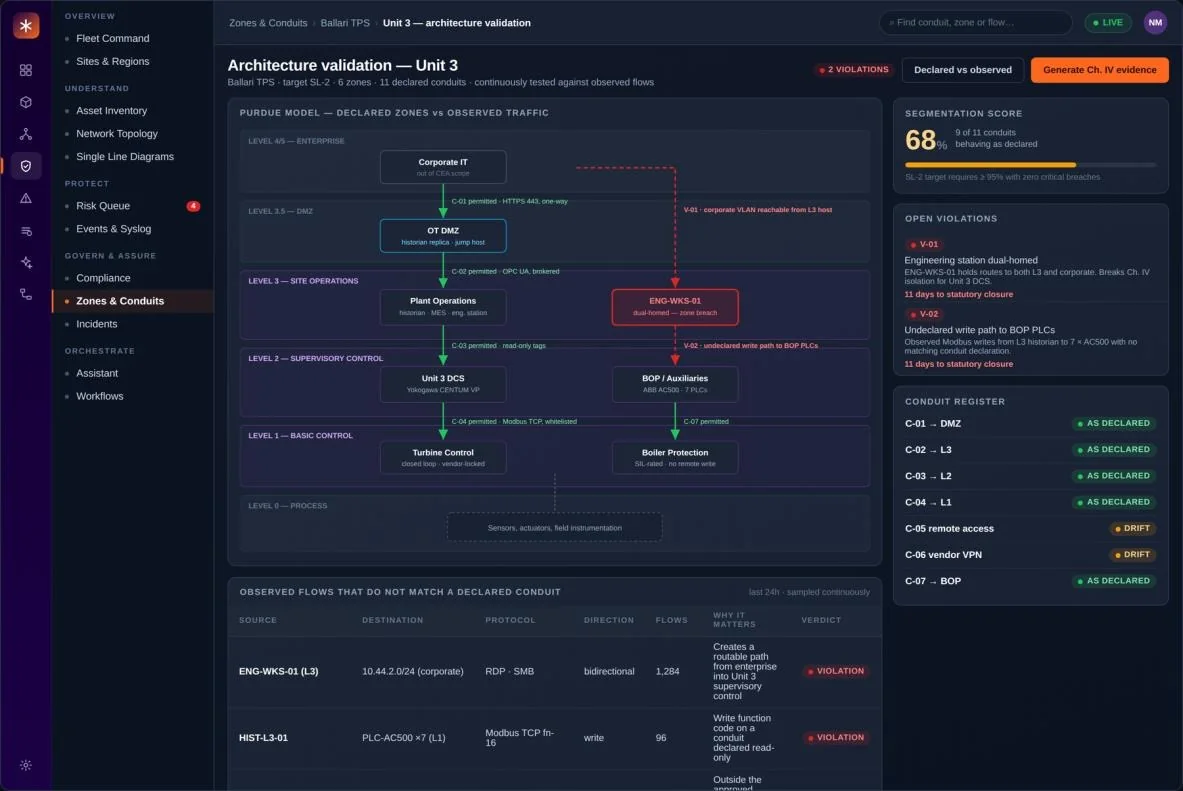
Chapter IV asks an operator to prove trust-level segmentation, not describe it. Declared zones and permitted conduits are continuously tested against observed traffic, and every mismatch becomes a dated finding.
Risk Queue
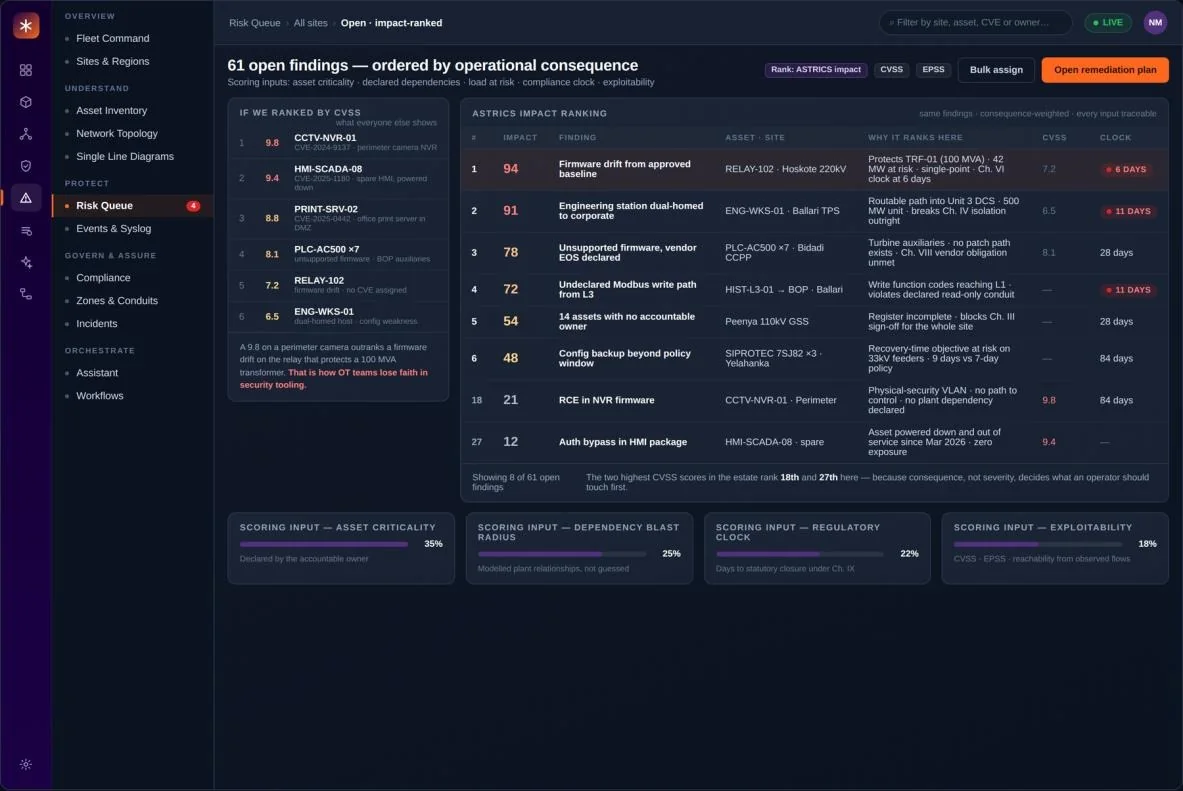
The same vulnerability data everyone has, ordered by what it would cost this operator. The two highest CVSS scores in the estate rank 18th and 27th here — because consequence, not severity, decides the work.
Operational Assistant
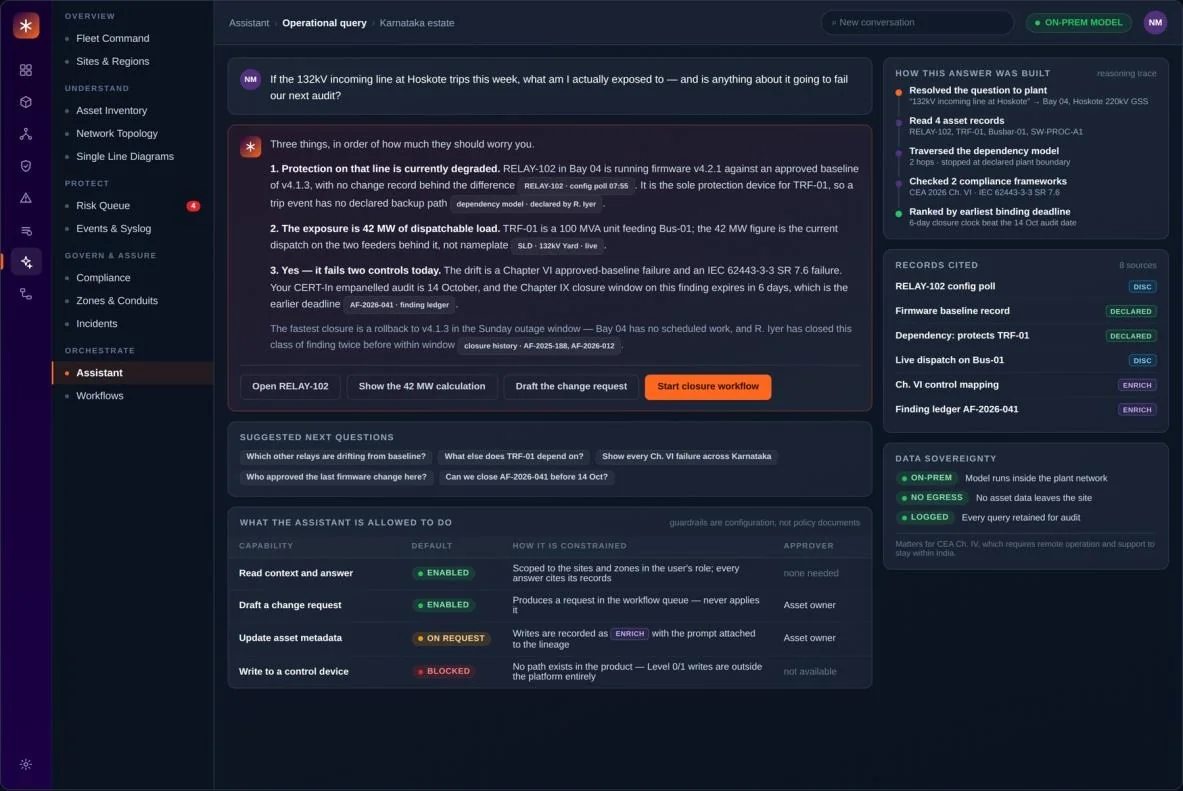
An on-premises assistant that cites the record behind every claim and shows the context it read. Writes to control devices are not a permission it can be granted — that path does not exist in the product.
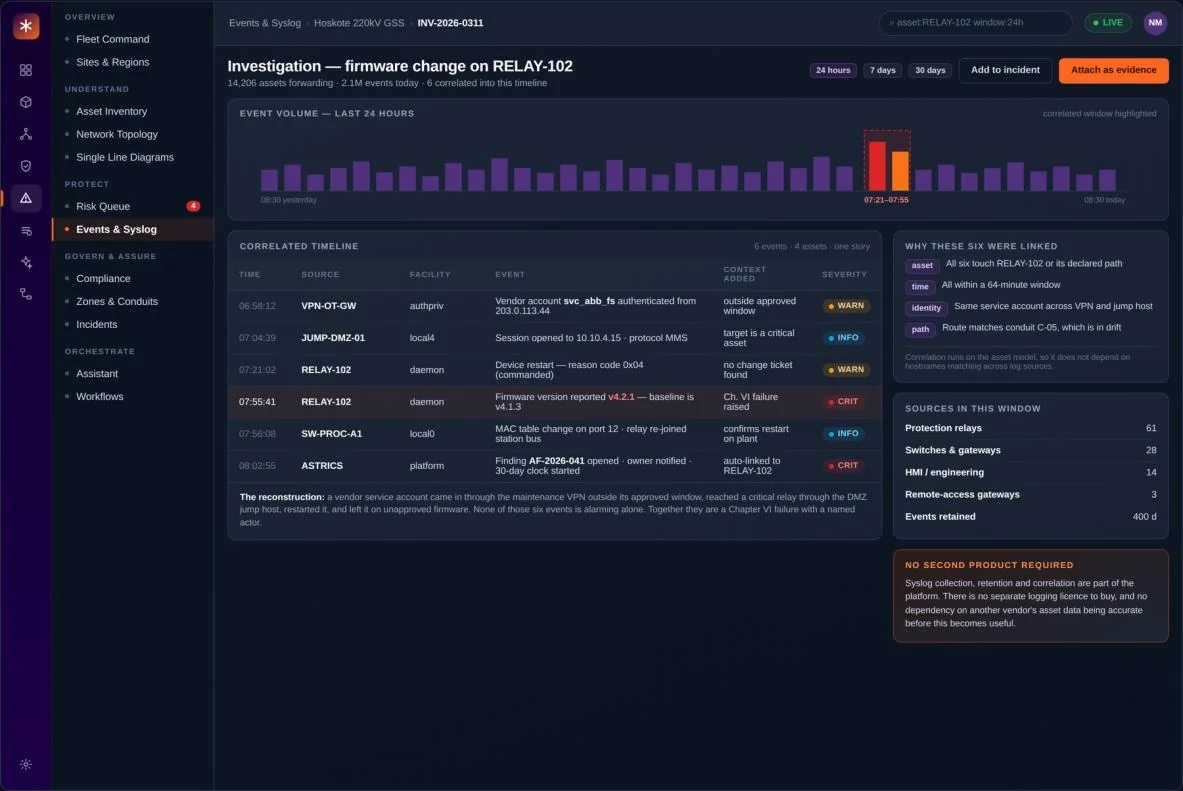
Events & Syslog
Native collection, retention and correlation — no second logging product, and no dependency on another vendor's asset data being right first. Correlation runs on the asset model, not on hostnames matching across log sources.
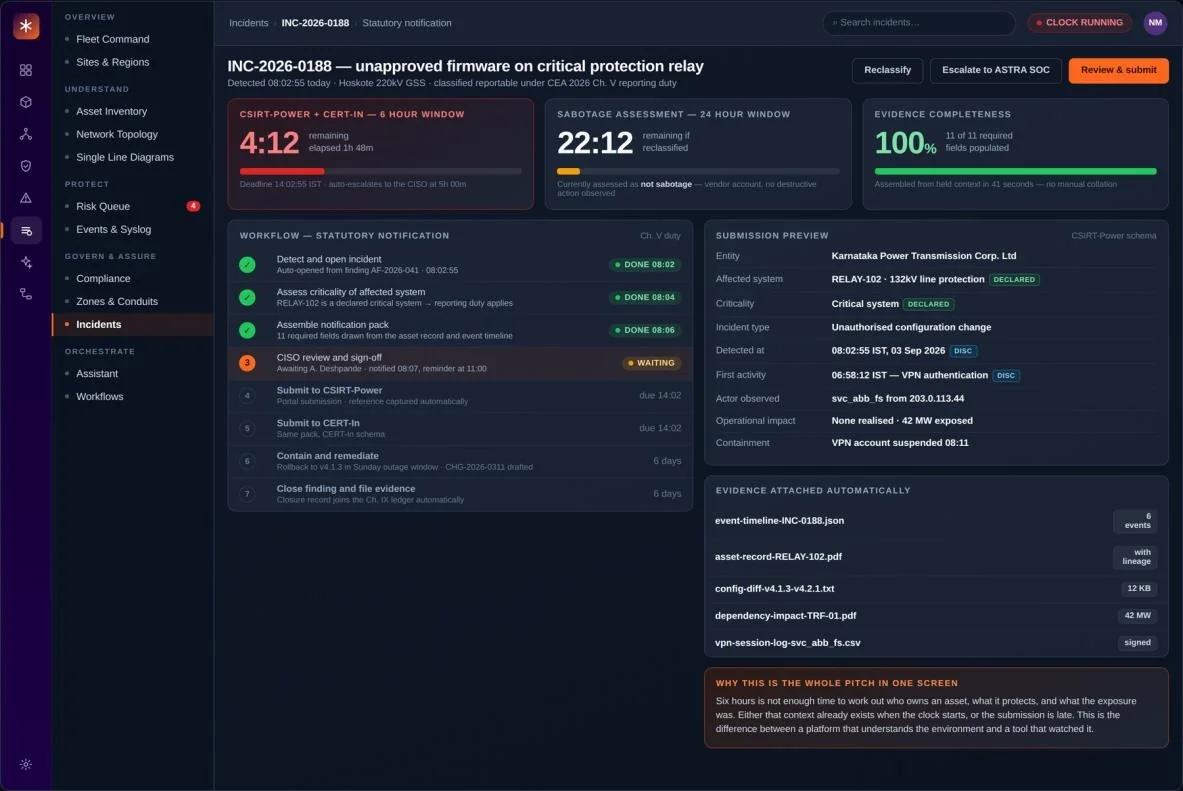
Statutory Incident Response
CEA 2026 allows six hours to notify CSIRT-Power and CERT-In. The clock, the workflow and the submission all run inside the platform, assembled from context already held.
See ASTRICS against your own environment.
Book a walkthrough with the ASTRICS team and bring one site's worth of questions.